FREE
circuits!
Recently added diagrams and projects

February 13, 2014
The clock movement is made in Korea by "Sau Jin LTD" "Dae Woo CO LTD" and has no jewels. It measures 4.5 inches diameter by 1.5 inches deep plus 1.5 inches for the hands and... [more]
January 18, 2011
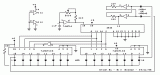
The bi-directional sequencer uses a 4 bit binary up/down counter (CD4516) and two "1 of 8 line decoders" (74HC138 or 74HCT138) to generate the popular "Night Rider" display. A Schmitt Trigger oscillator provides the clock... [more]


January 18, 2011
When power is applied, the 15K resistor and 10uF cap at pin 15 will reset the counters to the zero count where pin 3 is at +12 and all other outputs are at zero. The... [more]


January 18, 2011
The LED flasher circuits below operate on a single 1.5 volt battery. The circuit on the upper right uses the popular LM3909 LED flasher IC and requires only a timing capacitor and LED. [more]
January 16, 2011
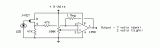
Here's a circuit that takes advantage of the photo-voltaic voltage of an ordinary LED. The LED voltage is buffered by a junction FET transistor and then applied to the inverting input of an op-amp with... [more]

January 16, 2011
This circuit is used to slowly illuminate and fade a pair of red LEDs (light emitting diodes). The fading LEDs could be installed as 'eyes' in a small pumpkin or skull as a Halloween attraction,... [more]

January 16, 2011
This circuit is similar to the "Fading Red Eyes" circuit (in the LED section) used to fade a pair of red LEDs. In this version, the lamps are faded by varying the duty cycle so... [more]

January 16, 2011
In the circuit, a quad voltage comparator (LM339) is used as a simple bar graph meter to indicate the charge condition of a 12 volt, lead acid battery. A 5 volt reference voltage is connected... [more]
 All posts