FREE
circuits!
 If you are not satisfied with search results, try browsing categories manually
Search: 555 timer
August 8, 2010
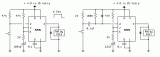
The two circuits illustrate using the 555 timer to close a relay for a predetermined amount of time by pressing a momentary N/O push button. The circuit on the left can be used for long... [more]
August 8, 2010
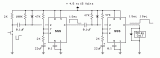
The circuit illustrates generating a single positive pulse which is delayed relative to the trigger input time. [more]
August 8, 2010
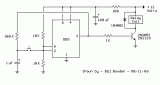
This 555 timer circuit toggles a relay when a button is pressed. Pins 2 and 6, the threshold and trigger inputs, are held at 1/2 the supply voltage by the two 10K resistors. When the... [more]

August 3, 2010
This circuit features an intermittent siren output and automatic reset. It can be operated manually using a key-switch or a hidden switch; but it can also be wired to set itself automatically when you turn-off... [more]
December 27, 2010
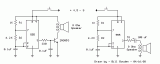
This is a basic 555 squarewave oscillator used to produce a 1 Khz tone from an 8 ohm speaker. In the circuit on the left, the speaker is isolated from the oscillator by the NPN... [more]

December 10, 2010
Here the popular 555 timing IC, is wired as a monostable. The timing period is precise and equivalent to: 1.1 x R1 x C1 [more]


June 22, 2010
These two circuits are multi-range timers offering periods of up to 24 hours and beyond. Both are essentially the same. The main difference is that when the time runs out, Version 1 energizes the relay... [more]
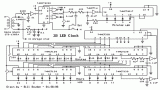
June 22, 2010
This is a programmable clock timer circuit that uses individual LEDs to indicate hours and minutes. [more]

August 8, 2010
This is a programmable clock timer circuit that uses individual LEDs to indicate hours and minutes. 12 LEDs can be arranged in a circle to represent the 12 hours of a clock face and an... [more]
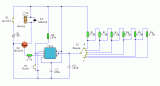
June 22, 2010
A switched timer for intervals of 5 to 30 minutes incremented in 5 minute steps. [more]

August 8, 2010
This circuit provides a visual 9 second delay using a 7 segment digital readout LED. When the switch is closed, the CD4010 up/down counter is preset to 9 and the 555 timer is disabled with... [more]

August 8, 2010
This circuit provides a visual 9 second delay using 10 LEDs before closing a 12 volt relay. When the reset switch is closed, the 4017 decade counter will be reset to the 0 count which... [more]
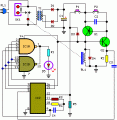
August 8, 2010
The purpose of this circuit is to power a lamp or other appliance for a given time (30 minutes in this case), and then to turn it off. It is useful when reading at bed... [more]
circuit from:http://www.extremecircuits.net/2009/12/bedside-lamp-timer-circuit-schematic.html

August 9, 2010
This circuit has an adjustable output timer that will re-trigger at regular intervals. The output period can be anything from a fraction of a second to half-an-hour or more - and it can be made... [more]

September 27, 2010
This timer was designed for people wanting to get tanned but at the same time wishing to avoid an excessive exposure to sunlight. A Rotary Switch sets the timer according to six classified Photo-types (see... [more]
circuit from:http://www.extremecircuits.net/2009/12/tan-timer-circuit-diagram.html

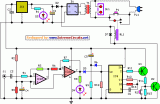
August 8, 2010
This circuit turns-off an amplifier or any other device when a low level audio signal fed to its input is absent for 15 minutes at least. Pushing P1 the device is switched-on feeding any appliance... [more]
circuit from:http://www.extremecircuits.net/2010/01/amplifier-timer-circuit-schematic.html


December 12, 2010
he purpose of this circuit is that of power a lamp or other apparatus for a given time (30 minutes in this case), and then to turn it off. [more]
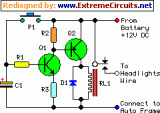
September 26, 2010
This device is a simple timer, allowing to keep on the headlights of your vehicle for about 1min. and 30sec., e.g. when accessing some dark place, without the necessity of coming back to switch-off the... [more]
circuit from:http://www.extremecircuits.net/2010/01/car-headlights-timer-circuit-schematic.html

August 9, 2010
This timer will provide a sequence of up to ten separate events. The length of each event is set independently. And the sequence will run a fixed number of times - or repeat continuosly. The... [more]

August 8, 2010
This is a combination digital clock timer and solar panel charge controller used to maintain a deep cycle battery from a solar panel. The timer output is used to control a 12 volt load for... [more]
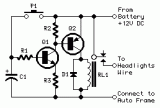
November 8, 2010
This device is a simple timer, allowing to keep on the headlights of your vehicle for about 1min. and 30sec., e.g. when accessing some dark place, without the necessity of coming back to switch-off the... [more]

November 8, 2010
This circuit was developed since a number of visitors of this website requested a timer capable of emitting a beep after one, two, three minutes and so on, for jogging purposes. [more]
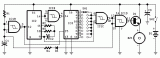
August 8, 2010
This circuit was developed since a number of visitors of this website requested a timer capable of emitting a beep after one, two, three minutes and so on, for jogging purposes. As shown in the... [more]
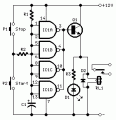
August 8, 2010
This timer was designed mainly to switch off a portable radio after some time: in this way, one can fall asleep on the sand or on a hammock, resting assured that the receiver will switch... [more]

December 8, 2010
A switched timer with equal make and equal space periods timing adjustable from over 6 minutes to 38 minutes. [more]

November 18, 2010
Time is set by potentiometer R2 which provides a range or 1 sec. To 100 seconds with timing capacitor C1 of 100uF. The output at pin 3 is normally low and the relay is held... [more]

April 29, 2010
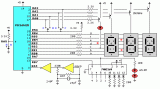
This clock timer uses a PIC16F628 microcontroller to display 3 and 1/2 digit time and control an external load. The clock includes a calendar with leap year and optional daylight savings adjustments. The timer output... [more]
April 29, 2010
This circuit uses the PIC16F628 microcontroller to provide 4 timed outputs that can be programmed from 1 minute to 1 week. An extra 8 bit shift register (74HC164) is used for the 4 timer outputs... [more]

August 8, 2010
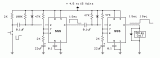
This toggle circuit operates by using a couple 555 timers wired as inverters. Pins 2 and 6 are the threshold and trigger inputs to the first timer and pin 5 is the output. The output... [more]

December 9, 2010
This circuit has an adjustable output timer that will re-trigger at regular intervals. The output period can be anything from a fraction of a second to half-an-hour or more - and it can be made... [more]

August 9, 2010
This is a simpler repeating timer circuit. It uses just one Cmos IC - wired as an asymmetric oscillator. The length of time the relay remains energized - and the length of time it remains... [more]

August 8, 2010
This circuit is very similar to Repeating Interval Timer No.2 . However - the addition of a light dependent resistor means that the operation of this timer can be limited to the daylight hours. A... [more]

August 8, 2010
This circuit is the opposite of Repeating Timer No.3 . Its operation can be limited to the hours of darkness. Again - the variable resistor (preset) lets you choose the level of darkness at which... [more]

August 8, 2010
This circuit is a temperature controlled version of Repeating Timer No.3 . The light dependent resistor has been replaced by a temperature dependent resistor or thermistor. And a small preset potentiometer lets you choose the... [more]

August 8, 2010
This circuit is the opposite of Repeating Timer No.5. It will only begin to operate if the temperature falls below the preset level. Again - the variable resistor (preset) lets you choose the temperature below... [more]

November 9, 2010
This timer was deliberately designed for people wanting to get tanned but at the same time wishing to avoid an excessive exposure to sunlight. [more]

August 8, 2010
A small circuit that can find a lot applications of measurement time. [more]
 All posts